Precipitation systems and atmospheric moisture budget
This work investigates the dynamics of regional hydroclimates, with an emphasis on understanding the processes that govern precipitation variability, atmospheric moisture transport, and land–atmosphere interactions. A central focus lies in dissecting the atmospheric moisture budget and studying both local contributions, such as moisture recycling from land and water bodies, and remote influences via large-scale circulation patterns.
Past work:
- Atmospheric moisture and precipitation seasonality in the Great Lakes Region (Minallah & Steiner 2020).
- CMIP6 model evaluation of moisture transport, convergence, and precipitation recycling (Minallah & Steiner 2021a).
- Precipitation variability and shifts in Monsoon timing in the Indus River Basin (Minallah & Ivanov 2019).
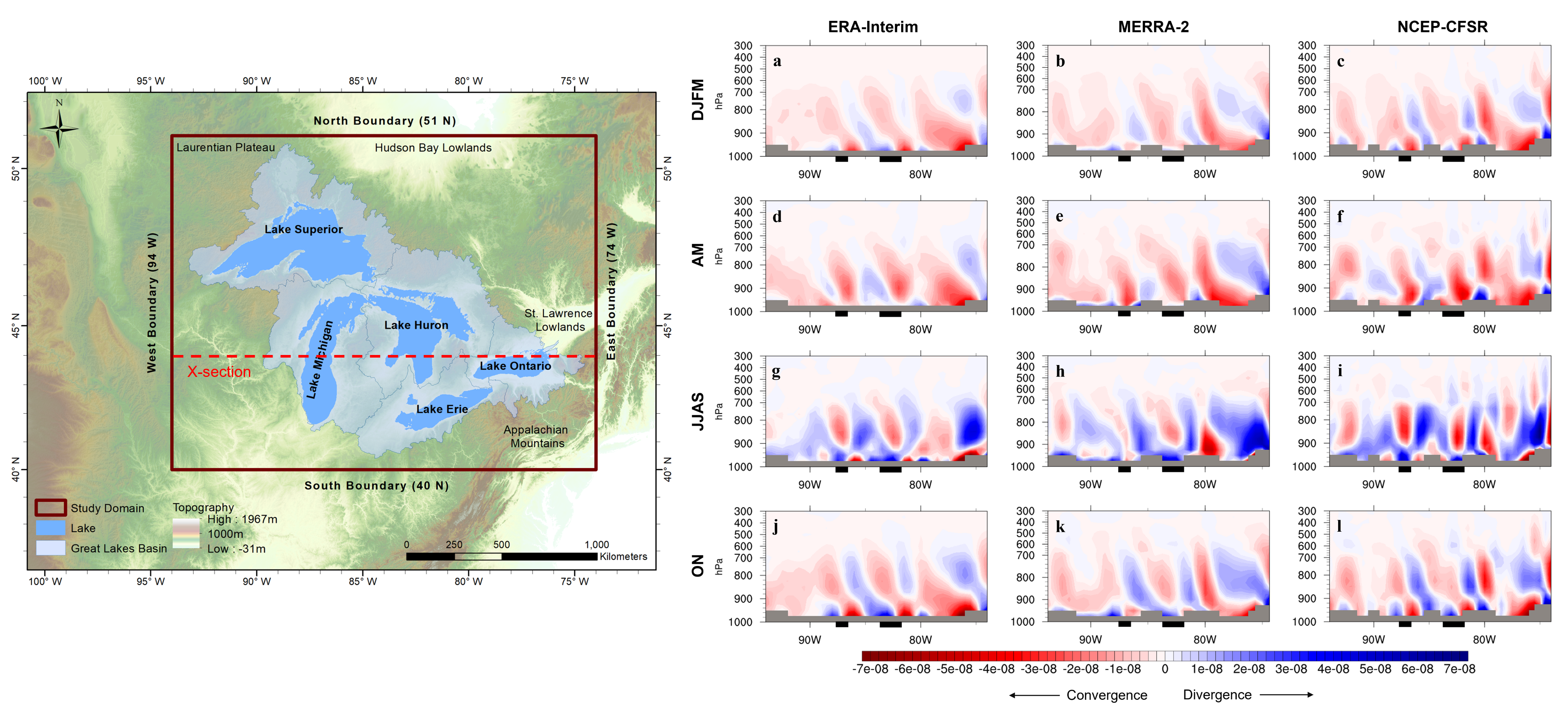
Figure: Atmospheric cross section of moisture flux divergence at 44°N in the Great Lakes region for four seasons using three reanalysis datasets. The locations of Lakes Michigan and Huron are marked in black along the x-axis. Local features such as water bodies and topography influence the vertical structure of atmospheric moisture fluxes, generating alternating patterns of convergence and divergence that can drive important localized phenomena, such as lake-effect precipitation.
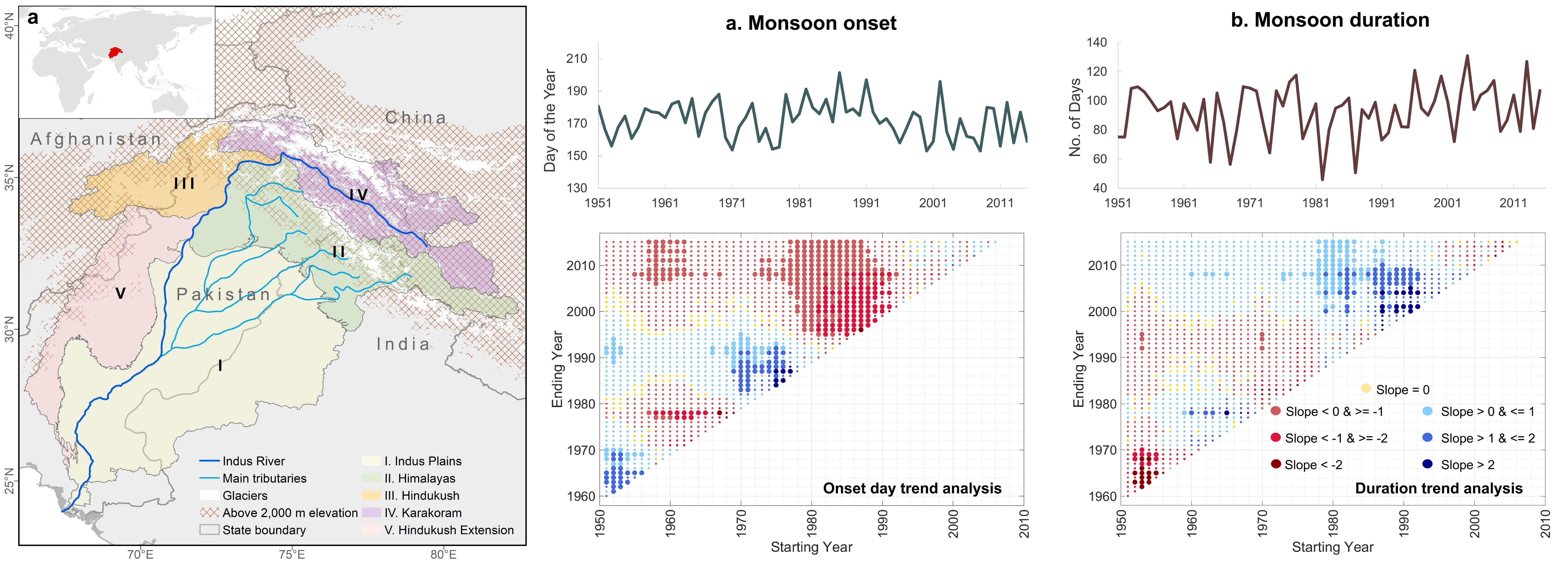
Figure: Trend analysis of monsoon onset dates and duration in the Himalayan region of the Indus River Basin, based on a Bayesian inference method that identifies changepoints in atmospheric moisture and precipitation thresholds. The figure highlights decadal and interdecadal trends, distinguishing stationary periods from statistically significant positive or negative trends (indicated by large circles). The trend slopes are expressed in days per year and red shading indicates trends toward earlier onset or shorter monsoon duration.
Mountain glaciers and geohazards back to top
Ongoing work:
- Utilizing CTSM–Hillslope Hydrology to resolve sub-grid topographic controls (aspect, relief, and slope) for improved representation of glacier mass balance estimates in mountain regions (Role: project lead; Status: early-stage development).
- Linking glacier dynamics with slope stability modeling to investigate glacier-driven geohazards, particularly the de-buttressing and mechanical unloading of valley walls associated with glacier thinning and retreat (Role: project lead; Status: exploratory phase).
Past work:
- Three-dimensional dynamic modeling of mountain glaciers using the Community Ice Sheet Model (CISM) (Minallah and Lipscomb, et al. 2025).
- Contributions to the Glacier Model Intercomparison Project Phase 3 (GlacierMIP3) (Zekollari & Schuster, at al. 2025).
- Study of Karakoram Glaciers using the Open Global Glacier Model (OGGM) (Minallah 2022, Chapter 6).
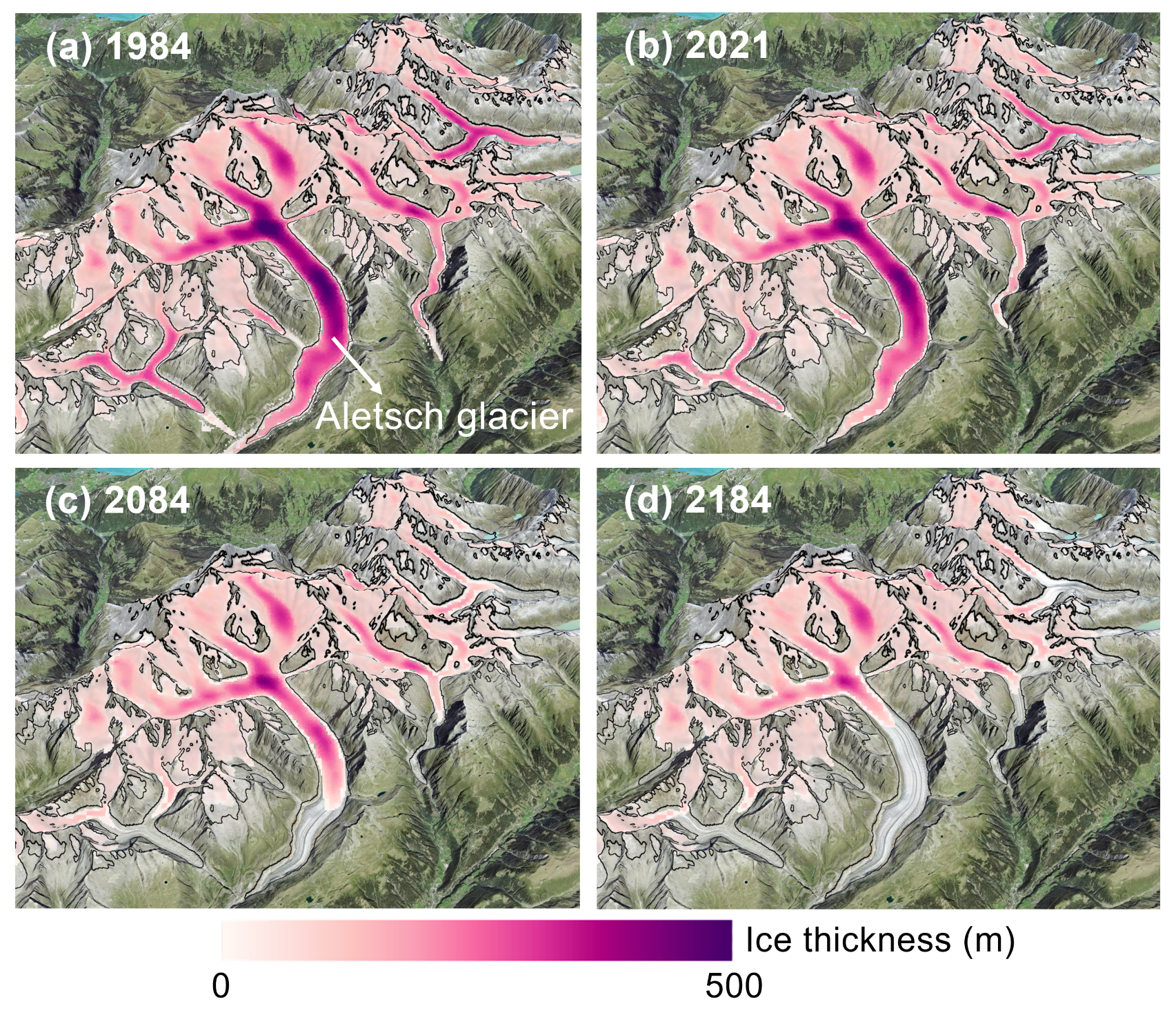
Figure: Committed ice loss for the glaciers in the Bernese Alps as simulated in CISM, if the present-day (2000–2019) climate persists with no further warming.
Terrestrial hydrology back to top
Ongoing work:
- Integrating satellite and field observations with the CTSM-Hillslope Hydrology model to enhance the accuracy of terrestrial energy and water budget estimates, with a focus on sub-seasonal to seasonal snowpack dynamics. (Role: PI; Status: proposal stage).
- Developing metrics to evaluate and reduce hydrological sensitivity biases, and to assess the robustness of Earth System Models (ESMs) for hydrological projections (Role: collaborating researcher; PI: Andy Wood).
Past work:
- Identifying the controls of spatiotemporal variability in the Great Lakes terrestrial water budget and analyzing the interdependencies among the budget components to inform hydroclimatic assessments under changing climate and land use conditions (Minallah, et al. 2023).
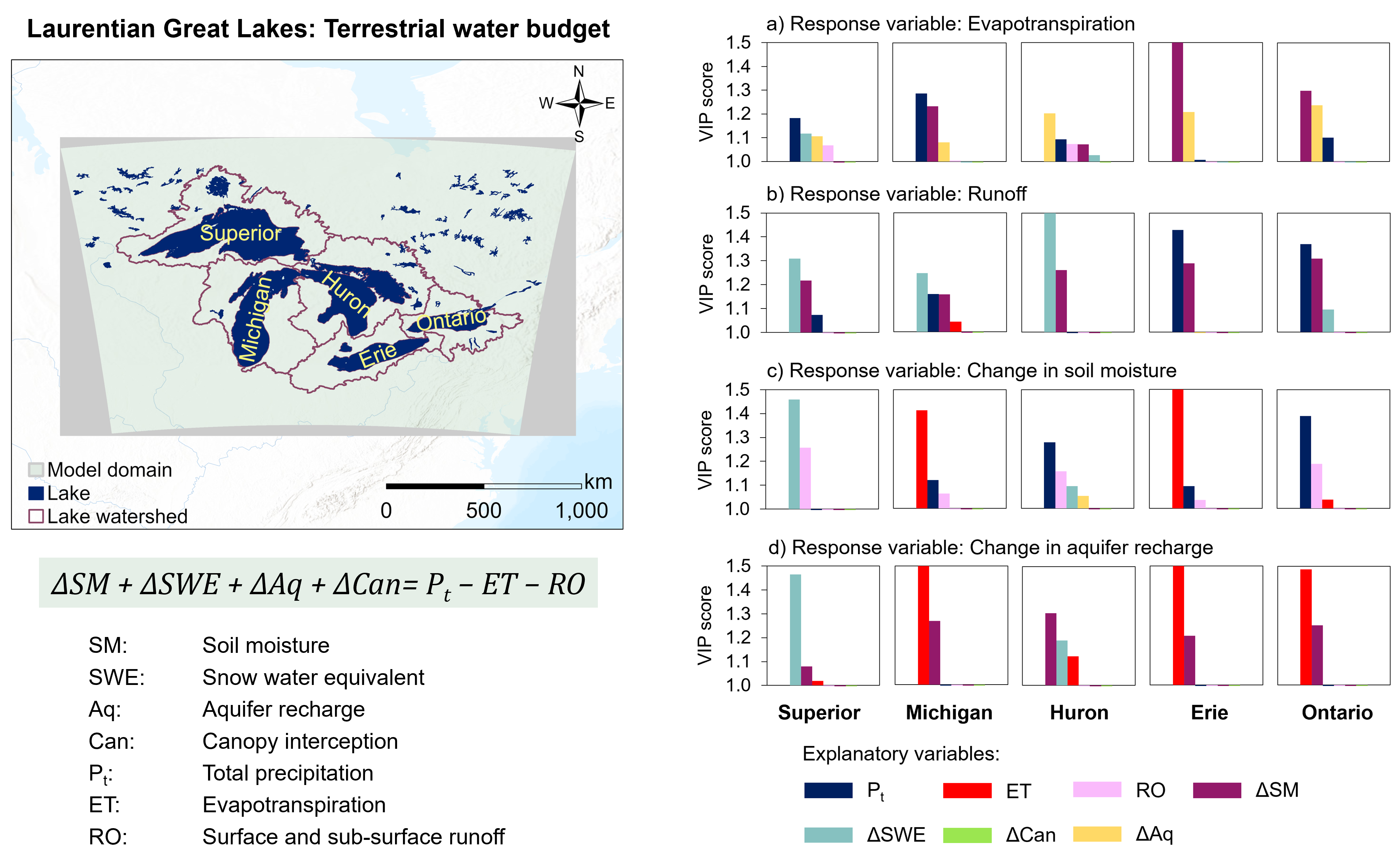
Figure: Variable importance in projection (VIP) scores from the Partial Least Squares Regression (PLSR) analysis for the five Great Lakes watersheds, evaluated across four response variables and seven explanatory variables from the terrestrial water budget.
Climate variability and predictability back to top
Developing decadal climate projection services for hydroclimatic extremes over North America: This ongoing work aims to establish a process-based understanding of the predictive relationships between decadal modes of variability (MOVs) and various extremes (wildfires, droughts, and floods) using both models and observational data. This includes implementing a framework to assess the predictability of extreme indices from large-scale climate modes by isolating internal variability and quantifying its contribution to decadal-scale predictability (Role: researcher; PI: Steve Yeager).
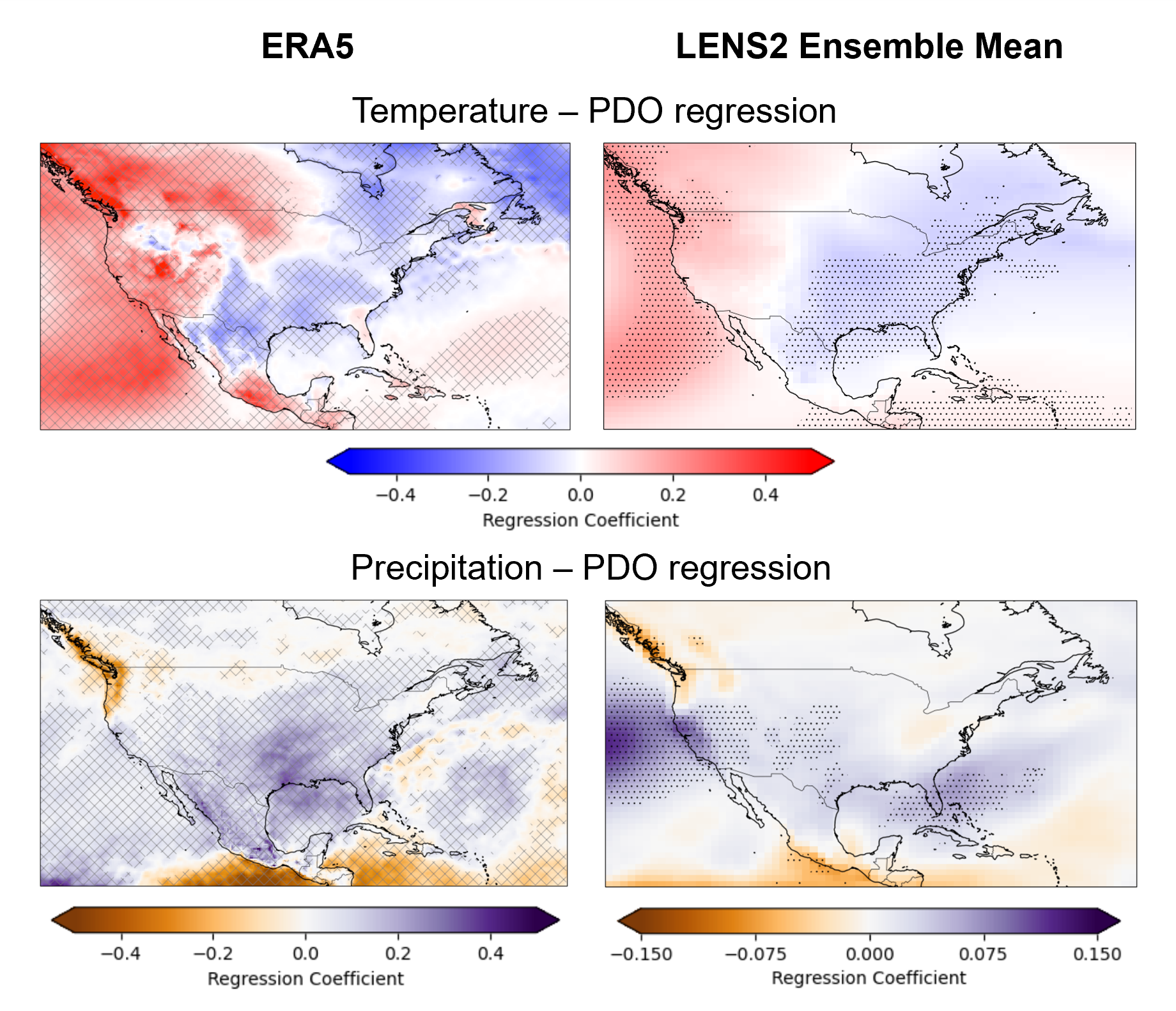
Figure: Regression of temperature and precipitation anomalies onto the Pacific Decadal Oscillation (PDO) index, using ERA5 reanalysis and the 100-member ensemble mean of the CESM2 Large Ensemble (LENS2). This comparison isolates the internal component by removing the forced signal from both ERA5 and LENS2, following the approach described in Deser & Phillips 2023.
Lake systems back to top
Past work:
- Assessment of lake–atmosphere interactions using case studies from the African Great Lakes, the Laurentian Great Lakes, and Lake Baikal, emphasizing how model representations of lakes affect regional hydroclimate simulations (Minallah & Steiner 2021b).
- Evaluation of observed and renalysis data in the Laurentian Great Lakes region (Fry, et al. 2022).
Related activities:
I convene the session on Lakes and Inland Water Bodies at the AGU Fall Meeting every year (since 2020). If you are interested in contributing as a co-chair or judging OSPAs, please contact me.
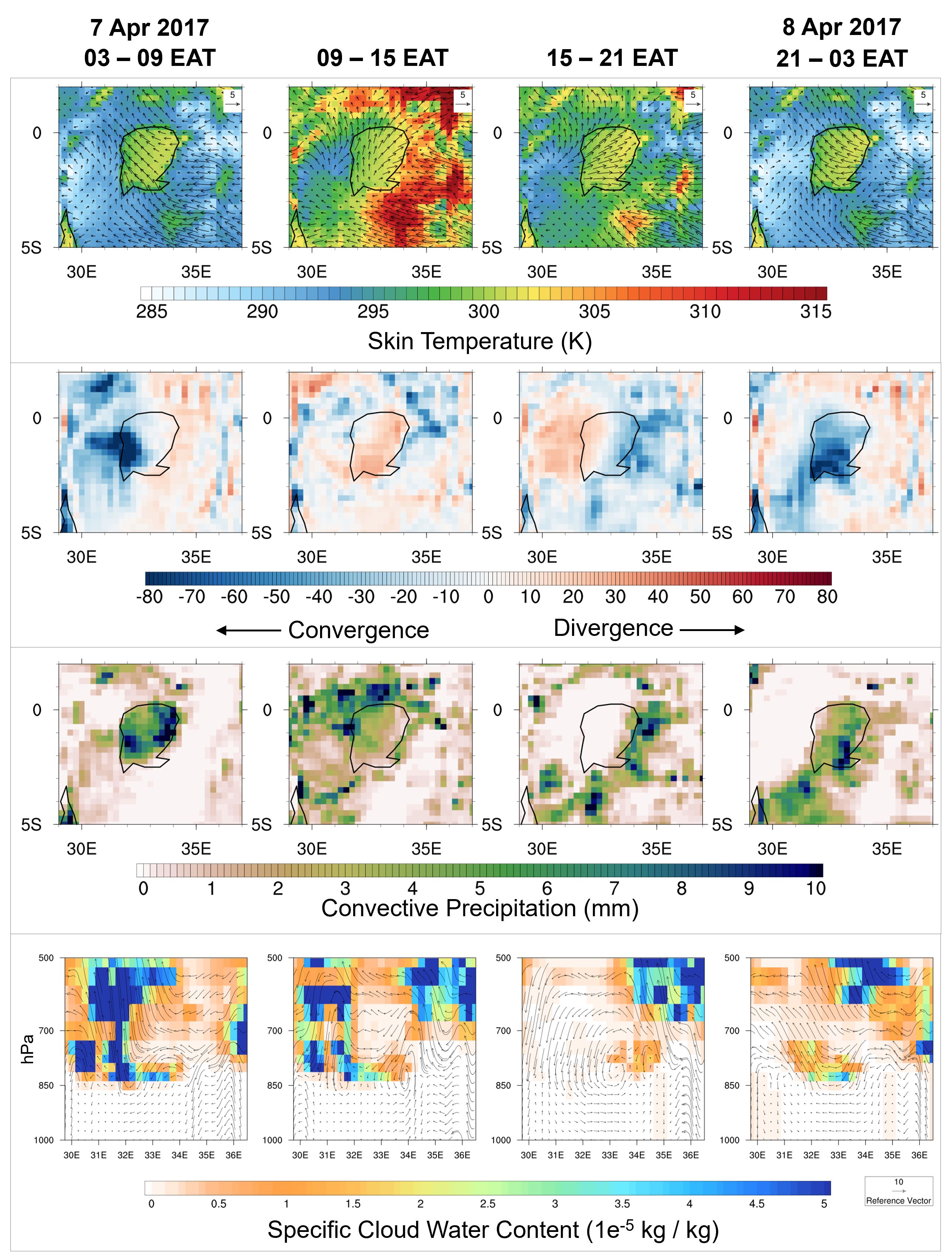
Figure: In the Lake Victoria vicinity, diurnal land–lake temperature contrasts strongly influence regional atmospheric dynamics, often triggering intense thunderstorms. This figure illustrates these dynamics during a severe event on 7–8 April 2015, showing the land–lake temperature differences, vertically integrated moisture flux convergence, convective precipitation, the vertical profile of cloud water content at 1°S, and associated wind patterns.